June 07, 2013

100 Greatest Indian Films: A List by CNN-IBN

This is perhaps the first 'Greatest Movies' list made to cover Indian cinema in general, and not just Hindi films. Such lists are often a subject of debate and argument. But I am obsessed by collecting such lists and constantly checking my score. 

Good to see that more than 60% of the movies in the list are not in the Hindi language. Sad to know that my score is a lowly 39 out of 100. What is yours?


·      Raja Harishchandra (1913/ Silent/ Dadasaheb Phalke)
·      Sant Tukaram (1936/ Marathi/ VG Damle and Sheikh Fattelal)
·      Manoos (1939/ Marathi/ V Shantaram)
·      Haridas (1944/ Tamil/ Sundar Rao Nadkarni)
·      Meera (1945/ Tamil/ Ellis R Dungan)
·      Awaara (1951/ Hindi/ Raj Kapoor)
·      Mallishwari (1951/ Telugu/ BN Reddy)
·      Patala Bhairavi (1951/ Telugu/ KV Reddy)
·      Devadasu (1953/ Telugu/ Vedantam Raghavaiah)
·      Do Bigha Zamin (1953/ Hindi/ Bimal Roy)
·      Shyamchi Aai (1953/ Marathi/ PK Atre)
·      Andha Naal (1954/ Tamil/ S Balachander)
·      Pather Panchali (1955/ Bengali/ Satyajit Ray)
·      Aparajito (1956/ Bengali/ Satyajit Ray)
·      Do Aankhen Barah Haath (1957/ Hindi/ V Shantaram)
·      Harano Sur (1957/ Bengali/ Ajoy Kar)
·      Mayabazar (1957/ Telugu/ KV Reddy)
·      Mother India (1957/ Hindi/ Mehboob Khan)
·      Naya Daur (1957/ Hindi/ BR Chopra)
·      Pyaasa (1957/ Hindi/ Guru Dutt)
·      Apur Sansar (1959/ Bengali/ Satyajit Ray)
·      Kaagaz Ke Phool (1959/ Hindi/ Guru Dutt)
·      Kshudhita Pashan (1960/ Bengali/ Tapan Sinha)
·      Meghe Dhaka Tara (1960/ Bengali/ Ritwik Ghatak)
·      Mughal-e-Azam (1960/ Urdu-Hindi/ K Asif)
·      Jhinder Bandi (1961/ Bengali/ Tapan Sinha)
·      Kabuliwaala(1961/ Hindi/ Hemen Gupta)
·      Saheb Biwi Aur Ghulam (1962/ Hindi/ Abrar Alvi)
·      Narthanasala (1963/ Telugu/ KK Rao)
·      Charulata (1964/ Bengali/ Satyajit Ray)
·      Chemmeen (1965/ Malayalam/ Ramu Kariat)
·      Guide (1965/ Hindi/ Vijay Anand)
·      Galpa Holeo Satyi (1966/ Bengali/ Tapan Sinha)
·      Nayak (1966/ Bengali/ Satyajit Ray)
·      Padosan (1968/ Hindi/ Jyoti Swaroop)
·      Bhuvan Shome (1969/ Hindi/ Mrinal Sen)
·      Goopy Gyne Bagha Byne (1969/ Bengali/ Satyajit Ray)
·      Aranyer Din Ratri (1970/ Bengali/ Satyajit Ray)
·      Mera Naam Joker (1970/ Hindi/ Raj Kapoor)
·      Samskara (1970/ Kannada/ Pattabhi Rama Reddy)
·      Anand (1971/ Hindi/ Hrishikesh Mukherjee)
·      Pakeezah (1972/ Urdu-Hindi/ Kamal Amrohi)
·      Pinjra (1972/ Marathi/ V Shantaram)
·      Garam Hava (1973/ Urdu-Hindi/ MS Sathyu)
·      Kaadu (1973/ Kannada/ Girish Karnad)
·      Padatik (1973/ Bengali/ Mrinal Sen)
·      Shriman Prithviraj (1973/ Bengali/ Tarun Majumdar)
·      Zanjeer (1973/ Hindi/ Prakash Mehra)
·      Ankur (1974/ Hindi/ Shyam Benegal)
·      Deewar (1975/ Hindi/ Yash Chopra)
·      Katha Sangama (1975/ Kannada/ Puttanna Kanagal)
·      Sholay (1975/ Hindi/ Ramesh Sippy)
·      Agrahrathil Kazhudai (1977/ Tamil/ John Abraham)
·      Ghatashraddha (1977/ Kannada/ Girish Kasaravalli)
·      Pathinaru Vayadhinile(1977/ Tamil/ Bharathiraja)
·      Aval Appadithan (1978/ Tamil/ C Rudhraiya)
·      Maro Charitra (1978/ Telugu/ K Balachander)
·      Gol Maal (1979/ Hindi/ Hrishikesh Mukherjee)
·      Peruvazhiyambalam (1979/ Malayalam/ P Padmarajan)
·      Shankarabharanam (1979/ Telugu/ K Vishwanath)
·      Uthiri Pookkal (1979/ Tamil/ J Mahendran)
·      Maa Bhoomi (1980/ Telugu/ Goutam Ghose)
·      Akaler Sandhane (1981/ Bengali/ Mrinal Sen)
·      Ek Duuje Ke Liye (1981/ Hindi/ K Balachander)
·       Ranganayaki (1981/ Kannada/ Puttanna Kanagal)
·      Thanneer, Thanneer (1981/ Tamil/ K Balachander)
·      Metti (1982/ Tamil/ J Mahendran)
·      Umbartha (1982/ Marathi/ Jabbar Patel)
·      Jaane Bhi Do Yaaron (1983/ Hindi/ Kundan Shah)
·      Masoom (1983/ Hindi/ Shekhar Kapur)
·      Sagara Sangamam (1983/ Telugu/ K Vishwanath)
·      Paar (1984/ Hindi/ Goutam Ghose)
·      Saaransh (1984/ Hindi/ Mahesh Bhatt)
·      Anantaram (1987/ Malayalam/ Adoor Gopalakrishnan)
·      Halodhia Choraye Baodhan Khai (1987/ Assamese/ Jahnu Barua)
·      Mr India (1987/ Hindi/ Shekhar Kapur)
·      Nayagan (1987/ Tamil/ Mani Ratnam)
·      Pushpak Vimana (1987/ Silent/ SS Rao)
·      Thoovanathumbikal (1987/ Malayalam/ P Padmarajan)
·      Salaam Bombay (1988/ Hindi/ Mira Nair)
·      Oru Vadakkan Veeragatha (1989/ Malayalam/ Hariharan)
·      Parinda (1989/ Hindi/ Vidhu Vinod Chopra)
·      Shiva (1989/ Telugu/ Ram Gopal Varma)
·      Ishanou (1991/ Manipuri/ Aribam Syam Sharma)
·      Sandesham (1991/ Malayalam/ Sathyan Anthikad)
·      Manichitrathazhu (1993/ Malayalam/ Fazil)
·      Unishe April (1994/ Bengali/ Rituparno Ghosh)
·      Dilwale Dulhaniya Le Jayenge (1995/ Hindi/ Aditya Chopra)
·      Satya (1998/ Hindi/ Ram Gopal Varma)
·      Vanaprastham (1999/ Malayalam/ Shaji N Karun)
·      Hazaaron Khwahishen Aisi (2003/ English-Hindi/ Sudhir Mishra)
·      Maqbool (2003/ Hindi/ Vishal Bhardwaj)
·      Munnabhai MBBS (2003/ Hindi/ Rajkumar Hirani)
·      Black Friday (2004/ Hindi/ Anurag Kashyap)
·      Shwaas (2004/ Marathi/ Sandeep Sawant)
·      Harishchandrachi Factory (2009/ Marathi/ Paresh Mokashi)
·      Vihir (2010/ Marathi/ Umesh Kulkarni)
·      Anhey Ghorhey Da Daan (2011/ Punjabi/ Gurvinder Singh)
·      Deool (2011/ Marathi/ Umesh Kulkarni)
·      Shala (2011/ Marathi/ Sujay Dahake)

May 31, 2013

#5: Officially in Love


“Thank you for the movie today. It was a gift.” – Martin Scorsese’s ‘Hugo’ (2011) 

I hardly felt bad when my parents and brother left me that Sunday evening, my first day at hostel. The reality set in the following morning when I woke up at 5 am and found myself in a new and alien world. None of us knew each other, so we hardly talked while getting ready at the common wash basin. It was dark and gloomy and I felt a painful lump in my throat. Life had changed from that day. That afternoon, we were informed that the last two lectures have been cancelled for a movie screening! Our Principal, who was to be changed after my first month there, preferred sports and extra-curricular activities over studies. “Wow”, we thought, “and they call it the best school in this part of the world!” The movie screened that day from a VHS tape was Orson Welles’ “Macbeth” (1948). I hardly knew then that the actor-director was the maker of “the greatest film ever made” and that I would be idolizing him some 15 years later. That movie bored us all. I much preferred ‘Karan Arjun’ that I had watched only five days ago!

During the days that followed, ‘Karan Arjun’ was to soothe me in ways more than one. We had no source of entertainment except sports at specified hours and a couple of hours of TV on Sundays. During our leisure time in the hostel, my friends would ask me to sing film songs. Those born and brought up in today’s era of iPods and laptops can’t even understand what it was, as I sang and others, all in their beds, quietly listened. The song that I always ended up choosing was “Sooraj kab door gagan se” from ‘Karan Arjun’. I was reminded of my brother and my Mom every time I sang that, and possibly that emotion was felt in my voice. It’s often the distance from your loved ones that makes you realize the intensity of your love.

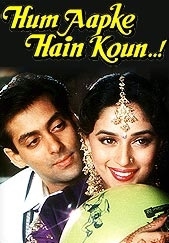
And the same happened with my first favorite film that I had watched nine days before joining hostel, with Mom and brother, reaching theater late and missing the opening credits. We had loved the film and kept talking about it, comparing our favorite moments and our favorite songs. But it was only after I left home that I realized how much I loved ‘Hum Aapke Hain Koun’ (1994). During the summer vacation, it was still running in our home town. Encouraged by Dad’s gesture of taking us to ‘Karan Arjun’, Mom suggested that we watch it again, this time with Dad. Surprisingly, he agreed. We went back to the same theater – Neelam Talkies, and missed the opening credits this time too. I don’t remember how much I read into the film, but it was to remain my favorite film for the next six years. It was also to give birth to the crazy cinephile in me around the end of 1999. How that happened will be covered in a later chapter, because this is dedicated to my first ‘official’ love!

Loving ‘Hum Aapke Hain Koun’ came naturally to me. It was so close to the world I lived in, the world of joint families that ate and danced together. And it was also as far away from reality as it should be – the romance of the lead pair was a stuff of the movies. At a time when Hindi cinema was at its shameful lowest, here came a film devoid of all formulae that were in practice. There was no effective villain except destiny, and no violence except one now-famous slap. Grace prevailed over vulgar hip-shaking dance numbers, and people sang for their loved ones in the family, and played household games. After it became such a huge hit, and created a trend that was to be used and abused for the following years, we feel the film itself was based on a contrived formula. It was not. It gave birth to the formula, and changed the content and commerce of Hindi popular cinema forever. I was to watch the film several times in the years that followed. Diwali 1997 was when it came on TV and I watched its Opening Song, only to be blown over. Imagine discovering an exceptional quality in your loved one, years after you have known her! And it was to happen again. Last month, I watched the film again and watched the song “Mujhse juda ho kar” for the first time as it was edited out of the versions I had seen before. And I so loved it, especially the moments where the lovers are imagining their marriage and their married life. I was haunted by the presence of Pooja, Nisha’s elder sister, in those dreams, because I knew the painful end she is going to have. And I wished – what if she had not died, what if they all lived together as they had imagined.

But if Pooja had not died, there would have been no ‘Hum Aapke Hain Koun’. Her death and everything that follows, which is covered only in the last half hour of the film, is its Conflict, Confrontation, and the Resolution. The entire 150 minutes before that is the Set-up. I have not seen a single film, from across the world that can entertain you, and hundreds of you sitting together, for more than two hours without any real conflict. It was the conviction of Sooraj Barjatya, who until today is my most revered film-maker, that he just made the audience spend time with these endearing characters, and made them fall in love with them and care for them. The audience was living with the family, attending their functions and playing games, and dreaming about the future, until that unexpected tragedy. No other film-maker that I have seen has managed to achieve this. Name some if you can think of, and please do not name Tarkovsky because we all know how difficult to watch his films are. To my relief, when I watched the film again last month, I could see the perfect ‘cinematic language’ used by Barjatya, something I could not have appreciated as a child. I was scared that my knowledge of film-grammar would spoil my first love. It didn’t. It can not. There is not a single shot in the film that does not seem to have born out of meticulous planning and a purposeful design. People who understand film grammar will agree to this even if they hate the film, that the writer-director had everything under his control, and it was not a fluke that this ‘marriage video’ made by a 28-year old went on to become the highest grossing Hindi film of all time, a record that was to be broken only in the new millennium.

From dreaming to buy a mandolin and eventually getting one after my Class X exams, to creating the story of an endearing family celebrating a child’s birthday (my first screenplay), ‘Hum Aapke Hain Koun’ is an inseparable part of me. It started this love-affair that eventually became my raison d’etre.

May 30, 2013

Must Watch Before You Die #35: Scenes from a Marriage (1973)


I love you in my selfish way, and I think you love me, in your fussy, pestering way. We love each other like people do here on earth...

There are two realities I have lived and experienced in the nearly three decades of my life, when it comes to the topic of marriage. Both realities are as intimate with me as they can be, and both are as opposite from each other as possible. And as expected, these realities reflect in my love for movies as well.

I was born and brought up in a world where marriage was, and still is, an undeniable truth of adult life. Small towns in our country, almost everywhere in this vast cultural collage that we call India, have a very traditional and typical way of looking at the institution of marriage. One has to marry after reaching a certain age, and mostly, the marriage is arranged by the elders of the families. Those getting married are supposed to accept the decisions of these elders with respect and dignity and, if possible, joy. Love marriages are rare, and if it is an inter-caste or inter-religion marriage it is almost certain that the families will not approve of it. It takes a lot of courage from a parent, who always claimed to have loved his or her child, to agree to that against the norms of the world around them. After marriage, the couple is expected to live through it in good times or bad and make sure the problems between them do not escape their bed-room. I have immense respect for such an institution of marriage. I am amazed to see how successful most arranged marriages are. It intrigues me how two families are bonded forever after one stressful night of unending rituals. It scares me to know how two people are almost forced to be united in body and soul without actually getting to know each other. It pains me to realize how a daughter leaves her home forever, to set-up a new world for herself. This reality is a part of my family, my traditions, their expectations from me, and I can never detach myself from it completely. This reality is the reason why I loved 'Vivah' (2006) despite its uni-dimensional characters and trite situations. I cried and smiled while watching that film, and I completely understand why the biggest success this film had was in the state of Bihar. If you accept the culture and beliefs of the people of that part of India, you will understand too.

However, I know that I do not want to be a part of that reality. And the answer to that is in the other reality that I discovered later. I left home when I was eleven. And have grown up to be an individual more concerned about himself than his family. I am more-or-less self-reliant in every way. However I long for someone to take care of me when I am not well, and bear my tantrums, and serve me good food every day. For the past eighteen years of my life, I have been away from all these privileges. All others from my world have got all this whenever they wanted. Add to this the kind of environment I was brought up in - eight years in an ashrama during my adolescence, and five years in an army institue during my early adulthood. My emotional side was almost forced to get suppressed by the intellectual disciplining of mind. I became more and more detached from my first reality. That my first love-affair ended badly did not help either. And around the same time, I discovered the expression of my self-centered, intellectual, alienated self in the cinema of Europe. Kieslowski became my favorite director and psychological dramas became my favorite genre. This new reality was a world of greys, complicated and difficult, less romantic than the world of Rajshri but very real. All my relationships after my first have been complicated. My sense of morality is pretty radical from that of the world around me, and I believe a man's biggest duty is towards himself. I also find myself not judging people but trying to understand the mechanism behind their allegedly wrong or right behaviour. I am completely fine with the morality of the lead characters in Kieslowski's 'White' (1994). If my people, back home, can accept the culture and beliefs of the world that is inside and around me, they too will be fine with it.

But most likely they will not. Ever. These two worlds will never understand each other. The characters from 'Vivah' will turn completely silent if they meet the characters from 'Three Colours: White'. The characters from the latter will possibly laugh at those from the first, but in their heart of hearts admire and envy them. And amidst these two conflicting worlds, marriage for me is and will remain a fascination, and a puzzle, that I will constantly try to figure out, whether I get married or not. It is a truth I can not close my eyes to. I will miss it if I don't experience it, and I will bear its pains if I do. As of now, I will leave it to destiny.

Ingmar Bergman's 'Scenes from a Marriage' (1973) will remind you of the films by Kieslowski. And it will remind you of the films by Gulzar. It will make you wonder how Sooraj Barjatya would react to it. Unlike any other Bergman film, a master film-maker whom I had always admired cerebrally for his surreal and philosophical dramas that never really tormented my heart or affected my soul, this film will make you think about your married life, whether you are married or not, and will remind you of all couples around you. Most importantly, it will make you cry miserably, deep within if not the actual act of weeping, and will connect you at an emotional level that you'd crave to go into the lives of the lead characters and help them out. But it will also make you believe that you can not. The man and the wife will have to do it themselves, amidst the magical bliss and the ugly pains that marriage brings with itself. Perhaps the only connection between the two realities is that the problems between the two should not leave the bed-room. Often, that is not the case.

Love. Finally.

Dear Shraddha,
I am in love. With you. It happened only a couple of days ago, and now I suddenly realize that I am very late. A little explanation is required and I hope you read on and let me tell you all that I want to.

Three years ago when I had first seen you in 'Teen Patti', I did find you immensely attractive. But the film was very unimpressive and your role was brief. Time went by, and although I always remembered how infatuated I was with you for some time, I never pursued you. And then, day before last, I watched your latest sensation, the film the entire trade is talking about, the film that has shattered various records at the box office and has surprised us all with its extra-ordinary run. I am sure you know all about it, including the fact that in the last 10 years, this film is the second highest fourth-week grosser, behind only '3 Idiots'. In the last ten years when we have seen huge numbers piled up by superstar-driven films, this little film of yours has managed to supersede all expectations. And let me tell you, a major portion of that revenue is actually a result of you and your work in the film, because you have done something in the film that no actress could do in recent times. Ask any man in the audience and you will know.

I apologize for going for the film almost a month after its release. I know you will never forgive me for that. But I tried to make up, you know. I watched it on Tuesday. And went back on Wednesday, this time only for you. I don't think I have ever done this. And I think I can go to watch it again. Not because I loved the film, but because I have fallen in love with you. I understand that I might be loving the 'image' of you projected on the screen. I do feel like Scottie from 'Vertigo', chasing the image of a woman played by an actress. (If you haven't watched that film, we will watch it together some day!) But somehow, I feel you and your character Aarohi are not two people. It seems both of you were born together, as one, and it will break my heart to see you doing the run-of-the-mill roles that other actresses are doing. If only my advice mattered, I would strongly advise you to keep playing the same character in all your films, because you have that rare quality of making men lose their sleep over you, in a way that is hardly lustful, but born out of the innocent charm that you possess. I am sure there must be millions of men like me, lost in your thoughts, and hoping to meet you some day.

Shraddha, I loved every moment of your presence on screen. I loved the way you brushed your delicate fingers against your wrists while singing your first lines of the song "Chahoon main ya naa', and later when you rehearsed in the balcony with your legs up the chair. I loved the way you said "nahin baba" with tears in your eyes, just before your first recording. I loved the way you ran up and down the stairs at the amphitheater, 'presenting' RJ to the audience. I loved the way you sat on the floor, against the door shut on you, trying to cajole him and help him. I loved the way you ran down the corridor of the recording studio and hugged him with that expression of infinite affection and unending support. I loved how your eyes were always fixed on him, whether in public or alone, as if everything that you were receiving was futile in front of the man you loved. And I loved the wonderful monologue you had just before the climax, when you talked about how you will accept 'his love' in order to bring him back. My eyes were wet throughout the film, looking at your beautiful face and worrying for you and wanting to take care of you. But that monologue broke my heart. I was crying. Your simplicity had won over me.

Looking at you, I felt you should be taken away from this cruel world to a land where all joys can be yours. From your fingertips to your hair, from your eyes to your smile, from your voice to your tears - I felt like treasuring them all. I have never felt like this for any other woman on screen. I am not a person who falls in love with heroines. I am not a person who falls in love so easily. But you have managed to do that. Today, I am dying to meet you, and tell you how special you are, and wish you all joys in the world. However, the biggest pain for me is that it indeed seems possible. I am not an unemployed goon-of-a-man lolling around the lanes of a my small town in Bihar, suddenly lovesick about an angel on the Big Screen. I am a professional working in the same industry as yours and the feeling that you are very much here, near me, and that there is a possibility that we could meet, however distant, is making me restless. As soon as I finished watching the film, I called up my manager-friend and asked him to get me your number. This mixed feeling of being near and yet so far is killing me.

So, I decided to write this letter to you. And leave it in the infinite cyber space. It is just one click away from you now. And I will wait for that fateful moment when you somehow receive this link, and click on it, and read my first love letter to you. I am hopeful it won't be my last.

Enjoy this success that you so truly deserve. And keep making the world a beautiful place by that wonderfully magical smile of yours.

Love,
Satyanshu.

P.S. I hope you don't take this letter as a trivial word play I do with every woman. Main us tarah ki ladkiyon se is tarah ki baatein nahin karta!

May 10, 2013

#4: Changing Times

"Choose carefully. Memories are all we end up with. At least pick the nice ones." - Juan Jose Campanella's 'The Secret in their Eyes' (2009) 

It must be some time in 1990. My Mom and my Bua were contemplating on recommending a movie to my Baba and Dadima. “This is a film they should not miss. It is more decent than they can imagine” – my Mom suggested and my Bua nodded. “Except, for the opening title sequence”, Mom thought out loud. “If it were not for that song, we could have definitely recommended it to them.” But my 20-year old Bua thought otherwise. “What’s wrong with that song? It’s the dance of Shiva and Parvati. I’m sure they won’t mind that!” And the two ladies burst out laughing.

My grandparents did not go to watch ‘Maine Pyaar Kiya’, the beautiful ‘family film’ that opened with a song where the shadows of two lovers, dressed in tights, danced with passion. The popular Hindi cinema of the early 90s was too embarrassing for such a suggestion to be made to them. Those were the times when ‘Sexy sexy sexy mujhe log bole’ played at Saraswati Puja near our house. Once on our trip to the holy town of Deoghar, the bus constantly played the song “Sarkaaye lo khatiya jaada lage, jaade mein balma pyaara lage…” On our way back perhaps I was missing that song that I started singing it. My mother snapped at me – “Don’t sing that song. It’s dirty.” I must have been nine then, too young to understand why that song was dirty. But yes, I did not sing that song before her ever in my life again.

After Bua got married, in 1993, our little domestic movie club was broken. My Mom still managed to watch some movies, very few indeed, when we were at school, with some neighbor or guest visiting our home. I remember how impressed she was with ‘1942: A Love Story’, especially how ‘clean’ it was. And I remember she narrated to us how Rahul Roy turned into a lion in ‘Junoon’. I haven’t watched that film yet, but it seems I have actually seen that scene of the ‘werewolf inspired’ transformation, so vivid was Mom’s description of it. She always had some insight into films that I could never think of. After watching ‘Saajan’, she remarked how by making Sanjay Dutt slightly bent over his walking stick, his tall frame did not appear too awkward with Madhuri and Salman by his side. While watching the opening credits of the movies on TV, I used to ask her what a ‘Nirmaata’ (Producer) or a ‘Nirdeshak’ (director) was. And when my teachers prepared us for an upcoming cultural program at school, I used to tell my friends which teacher was the ‘Nirmaata’ of this show and who the ‘Nirdeshak’ was. A couple of teachers once over-heard this conversation of mine. They were amused and smiled lovingly at me, their favorite student among all, one who barely spoke.

Dad, unlike what the first post of this series suggested, never regained his interest in the movies. In fact, he was not interested in anything except his work. But yes, when ‘Saudaagar’ released, even my Dad could not resist the temptation of watching Dilip Kumar and Raj Kumar back on the big screen. One evening, after making the two of us sleep, Mom and Dad went for the 9 pm show at Konark Talkies. As far as I remember, that was the only movie my Mom and Dad, just the two of them, watched together.

Amidst all this, something else was to change. Once on his trip to Deoghar, Dad found about this school-ashram that was known for its spiritual ambience, disciplined lifestyle, and wholesome education. He wanted me to prepare for its tough entrance exam. I attempted twice, after failing to get through the first time. Having trained under my Mom, that included 5 am study hours, getting admitted to Ramakrishna Mission Vidyapith was the first goal I consciously strove for. It was dreamt by my Dad, and my Mom and I fulfilled it. My admission into that prestigious institution was a matter of pride for my entire extended family. “Your son will now be an IAS officer” remarked my Dad’s friends. All knew this was a significant achievement in my life as a student. And perhaps no one knew, least of all I, that this was the first Plot Point in my life as a whole – an irreversible change, that was to transform a shy, introverted child into the boy I was to become. End of March, 1995, I left my home, never to return back, except for the small vacations. What happened after that and how it affected my life as a film-buff will form a major chunk of the posts to follow. But let me end this post with something totally unexpected that happened just a couple of days before I left home. My Dad took us for a movie! It was 22nd of March, my birthday, and Dad took all three of us – Mom, my brother, and me, to watch ‘Karan Arjun’ (1995). It was a rare birthday gift, when all four of us watched a movie together for the first time. That it happened two days before I left my home is perhaps one hint at the emotional side of the stern persona my Dad sported.